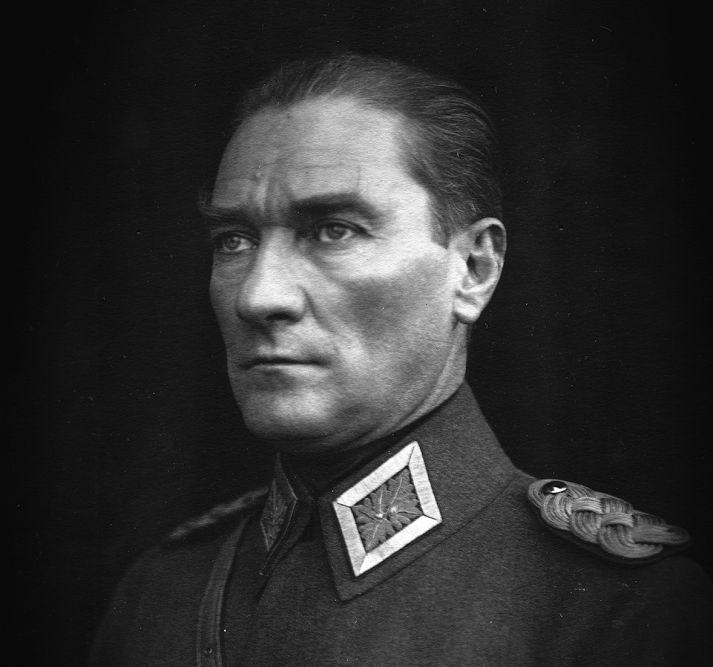
(1881 – 1938)
Mustafa Kemal Atatürk remains one of the most iconic and transformative figures in Turkish history: the founder of the Republic of Turkey, a brilliant soldier, a visionary reformer, and a national hero whose presence is still deeply felt across Turkey today.
Early Life and Childhood
Atatürk was born in 1881 in Selanik (modern-day Thessaloniki, Greece) when it was still part of the Ottoman Empire. His father was Ali Rıza Efendi, and his mother Zübeyde Hanım. His father died when Mustafa was very young — around the age of seven. After that, he lived for a while with his mother and sister on his uncle’s farm.
He began his schooling in a neighborhood religious school, but his education soon shifted to a more secular path. His keen intelligence and aptitude for mathematics earned him respect; one of his teachers gave him the name “Kemal”, meaning “perfection” or “maturity.” As a young boy, he was enamored by military life and the uniforms of cadets around his neighborhood, which helped shape his ambition to become a soldier.
He later attended the Monastir Military Secondary School and then the Istanbul Military Academy, graduating as an officer. Afterward, he went on to the War College in Istanbul, completing his training in 1905.

Character, Personality & Closest Friends
Atatürk was exceptionally disciplined, intellectual, and deeply dedicated. He combined military rigor with a keen commitment to modernization, secularism, and rational thought. He was known for his charisma, but also for being somewhat private, serious, and intensely focused.
Over his life, he forged several important friendships that would become pivotal in the founding of the Turkish Republic, including İsmet İnönü, Nuri Conker, Ali Fethi Okyar, and Ali Fuat Cebesoy.
Achievements & Why He’s a Turkish National Hero

Atatürk’s legacy is vast. Here’s why he remains a towering figure in Turkish consciousness:
- Founder of the Republic of Turkey
After the collapse of the Ottoman Empire in the aftermath of World War I, Atatürk led the Turkish War of Independence. On 29 October 1923, he formally declared the Republic of Turkey and became its first President. - Military Leadership
He distinguished himself as a commander in several critical battles. His role in Gallipoli (Çanakkale) is especially celebrated. - Radical Reforms
Atatürk introduced sweeping reforms to modernize Turkey:- Abolished the Ottoman caliphate and the sultanate, creating a secular republic.
- Changed the Turkish script from Arabic script to a Latin-based alphabet.
- Reformed the legal system, adopting European-style civil and penal codes.
- Promoted gender equality: women gained civil and political rights under his leadership.
- Prioritized education, science, and rationalism, believing that progress depended on knowledge.
- National Identity & Unity
Atatürk helped forge a modern Turkish national identity that moved away from Ottoman imperial identity toward a united, secular, and civic Turkish nation. - Symbol of Modernity
He is seen not just as a political leader, but as a symbol of Turkey’s leap into the 20th century — a man who broke with the old to build something new.
Why His Image Is Everywhere Today

Even decades after his death on 10 November 1938 in Istanbul, Atatürk’s legacy is omnipresent in Turkey:
- His portrait hangs in virtually every public building: schools, government offices, town halls.
- Many businesses, shops, and private homes display his image — a sign of respect and national pride.
- Anıtkabir, his mausoleum in Ankara, is a national shrine and site of annual commemoration.
- Monuments, statues, and sculptures of him are widespread — like the Republic Monument in Taksim Square, Istanbul, showing him as both military leader and statesman.
Legacy & Modern Reverence

Atatürk is often referred to as the “Father of the Turks” (“Atatürk” literally means “Father of Turks”). His legacy is taught in schools, celebrated in military parades, and honored every 10 November, the anniversary of his death, with ceremonies and moments of silence across the country.
He remains a unifying figure in Turkish politics, culture, and identity — even though modern Turkey has changed a lot since his day. Many Turks see him not only as a founder, but as a moral compass: a visionary whose commitment to secularism, democracy, and national sovereignty continues to shape debates about Turkey’s future.
In short: Mustafa Kemal Atatürk (1881 – 10 November 1938) was born in Selanik, rose through the military ranks, and became the architect of modern Turkey. With his reformist spirit, he transformed a crumbling empire into a secular republic — and his face, ideals, and name are still everywhere in Turkey, a testament to his enduring place in the nation’s heart.




Leave a Reply