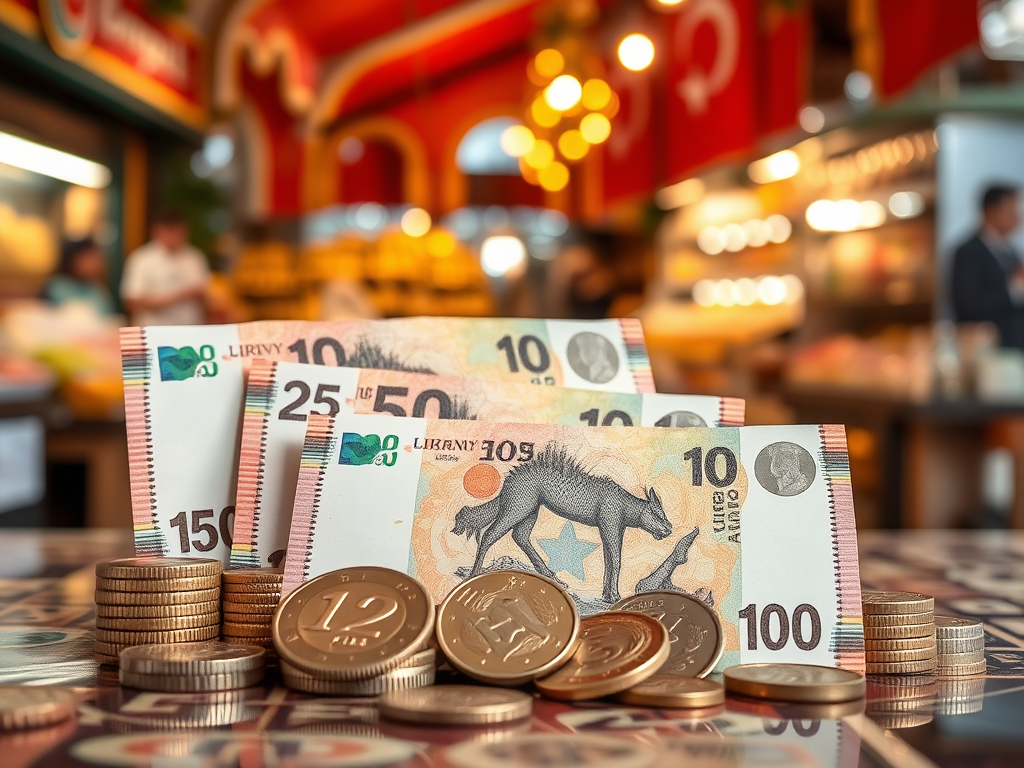
💷 How to Get the Best Exchange Rates
Changing money in Turkey is generally straightforward and safe, but the rates and fees can vary considerably depending on where and how you exchange your foreign currency. Tourists can find excellent rates throughout the country, particularly in large cities and coastal resorts, as long as they avoid a few common traps such as airport exchange desks and unofficial money changers.
💱 The Turkish Lira
Turkey’s official currency is the Turkish Lira (Türk Lirası – TRY / ₺), which is available in banknotes of ₺5, ₺10, ₺20, ₺50, ₺100, and ₺200, and coins ranging from ₺1 down to 5 kuruş. Although some tourist businesses quote prices in euros or dollars, it is almost always cheaper to pay in Turkish lira, as foreign currency prices often include a built-in mark-up.
🏧 Where to Change Money
There are several safe and convenient ways to change money in Turkey, each with its own advantages.
1. Official Exchange Offices (Döviz Bürosu)
These are the best and most popular option for tourists. Found in every city, town, and tourist area, they clearly display live electronic exchange rates outside the shop.
- Offer competitive rates, especially in city centres or tourist districts.
- No commission or hidden fees if you see “Komisyonsuz” (commission-free).
- Open long hours, including weekends.
- Some require your passport for larger transactions (usually over US $3,000 or equivalent).
To get the best rate, check two or three nearby bureaux before exchanging large sums.
2. Banks
Turkish banks such as Ziraat Bankası, İş Bankası, and Garanti BBVA also provide currency exchange services.
- Rates are generally slightly lower than bureau rates.
- Opening hours are Monday to Friday, 09:00–17:00.
- You may need to present your passport for any exchange.
Banks are a good choice for those preferring extra security or changing large amounts.
3. ATMs (Cash Machines)
Using an ATM is convenient and often gives an inter-bank rate close to the true market value. However, watch out for:
- Local ATM fees (typically ₺30–₺60 per withdrawal / £0.75–£1.50 / €0.85–€1.70 / $0.90–$1.80).
- Foreign-card surcharges added by your own bank or the ATM operator.
Always choose to be charged in Turkish lira, not in your home currency, to avoid poor conversion rates through Dynamic Currency Conversion (DCC).
4. Hotels and Airports
While convenient, airport exchange desks and hotel front-desk exchanges almost always offer the worst rates, often 10–20 % lower than city bureaux. It’s best to exchange only a small amount here for immediate expenses such as taxis or snacks, then use a reputable exchange office once you reach your destination.
⚠️ What to Avoid
- Street changers or tour agents offering “special rates” – these are unlicensed and illegal.
- Airport kiosks and hotel desks – extremely poor rates and hidden fees.
- Dynamic Currency Conversion (DCC) on ATMs or card machines – always decline and pay in lira.
- Old, damaged, or marked notes – Turkish bureaux may refuse them.
Always count your money carefully at the counter and keep your receipt until you’ve checked the amount.
📄 Documentation Requirements
For small or routine exchanges (under about ₺100,000 – roughly £2,500 / €2,800 / $3,000), no paperwork is required. For larger sums, or when exchanging foreign currency at a bank, you may need to show your passport or residence card. The teller will record your details in accordance with Turkish anti-money-laundering laws.
Tourists do not need to prove income or provide tax details to exchange cash. Credit and debit cards are widely accepted in shops, restaurants, and hotels, but smaller cafés and markets still prefer cash.
💰 Example Exchange Rates (Late 2025 Averages)
| Currency | Typical Mid-Market Rate | Airport Rate (−10 % to −20 %) |
|---|---|---|
| £1 | ≈ ₺40 | ₺32–₺36 |
| €1 | ≈ ₺36 | ₺29–₺33 |
| $1 | ≈ ₺33 | ₺26–₺30 |
(Actual rates fluctuate daily.)
✅ Summary
Exchanging money in Turkey is easy and safe if you stick to official bureaux de change (Döviz Bürosu) or banks in towns and tourist areas. Avoid changing large amounts at airports or hotels, and always check that the office displays a commission-free rate board. Bring your passport if exchanging larger sums, and never deal with unlicensed street traders. By following these simple steps, you’ll enjoy the best possible value for your money — and avoid unnecessary fees during your stay in Turkey.




Leave a Reply