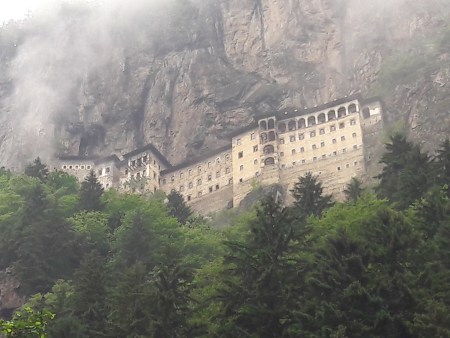
The Sumela Monastery in the province of Trabzon is the most visited tourist attraction on the Black Sea Coast. Just 50 km from Trabzon city, this breathtaking construction, built into a steep cliff, 1200 metres above sea level, is an absolute must in terms of places to visit. Getting there from Trabzon you head for Maçka and then turn off towards the Altındere Vadisi Milli Parkı ( Altindere Valley National Park ).
The scenery on route is absolutely amazing and will take your breath away. You will pass through rocky valleys and forested areas with streams and waterfalls before parking at the foot of the hill where you can take an official minibus to the start point from where you will walk up the footpath to reach the monastery. Please note that this path may not be suitable for those with disabilities and there are a number of stairs and some walking required to reach your destination.
Sumela or Soumela gets it name from the Greek ‘Sou Mela’ ( Black Mountain ). In the local Laz language it is referred to as Sumela ( Trinity ). The monastery is dedicated to the Virgin Mary and the site is often referred to as the Monastery of the Virgin Mary.
The reason that this site is so popular is in part due to the stunning natural beauty of the area and also the fact that the monastery has been constructed high up on a rock face. The monastery was closed during 2015 due to the risk of falling rocks and and re opened again in 2019. There is much renovation work taking place so expect sections to be closed or have only partial access. This is due mainly to complicated and time consuming restoration of the frescoes at various locations within the monastery complex.
Records do not tell us the exact date of the construction of the monastery. Legend has it that two monks from Athens founded the monastery during the reign of Theodosius I from 347 to 395 AD. During the reign of the Byzantine Emperor Justinian I in the 6th century some renovation work took places. During the 13th century it is well documented and part of the Empire of Trebizond. Most of what we see today dates back to the reign of Alexios Komnenos III, an Emperor of Trebizond until 1349. Note that the Empire of Trebizon ( Trabzon ) was an offshoot of the Byzantine Empire that was in existance from 1204 to 1461.
Monks would continue to live here until the Russians occupied Trabzon between 1916 and 1918. After the collapse of the Ottoman Empire and the population exchange between Greece and Turkey the monastary was abandoned. Due to fire in 1930, and subsequent vandalism and pillaging from treasure hunters, it was in a sorry state until the Turkish Ministry of Culture and Tourism stepped in to rectify the situation and open the site up to visitors.
Trabzon ilinde yer alan Sümela Manastırı, Karadeniz kıyısındaki en çok ziyaret edilen turistik yerdir. Trabzon şehir merkezine sadece 50 km uzaklıkta bulunan bu nefes kesici yapı, deniz seviyesinden 1200 metre yükseklikte, dik bir kayalığın içine inşa edilmiştir ve mutlaka görülmesi gereken yerler arasında yer alır. Trabzon’dan ulaşmak için Maçka yönüne gidilir, ardından Altındere Vadisi Milli Parkı yönüne sapılır.
Yol boyunca karşınıza çıkan manzaralar gerçekten büyüleyicidir. Kayalık vadilerden ve ormanlık alanlardan geçerken dere ve şelaleler size eşlik eder. Aracınızı tepenin eteğindeki otoparka bıraktıktan sonra, resmi minibüslerle patika başlangıcına ulaşırsınız. Buradan sonra manastıra kadar yürüyerek çıkmanız gerekir. Lütfen unutmayın: bu yol engelli bireyler için uygun olmayabilir. Ziyaretçilerin bir miktar merdiven çıkması ve yokuş yürümeleri gerekmektedir.
Sümela ya da orijinal adıyla Soumela, Yunanca “Sou Mela” yani “Kara Dağ” anlamına gelir. Lazca’da ise Sumela (Teslis – Üçleme) olarak bilinir. Manastır, Meryem Ana’ya adanmıştır ve sıkça “Meryem Ana Manastırı” olarak anılır.
Bu alanın bu kadar popüler olmasının sebebi yalnızca etkileyici doğası değil, aynı zamanda manastırın yüksek bir kaya yüzeyine inşa edilmiş olmasıdır. Manastır, 2015 yılında düşen kaya parçaları riski nedeniyle kapatılmış, 2019 yılında yeniden ziyarete açılmıştır. Hâlâ devam eden restorasyon çalışmaları nedeniyle bazı bölümlerin kapalı olması ya da kısıtlı erişime açık olması muhtemeldir. Bu çalışmaların çoğu, manastır kompleksi içindeki çeşitli noktalarda bulunan fresklerin karmaşık ve zaman alıcı onarımlarından kaynaklanmaktadır.
Manastırın tam olarak ne zaman inşa edildiğine dair kesin kayıtlar yoktur. Rivayete göre, manastır iki Atinalı keşiş tarafından, MS 347–395 yılları arasında hüküm süren I. Theodosius döneminde kurulmuştur. Bizans İmparatoru I. Justinianus’un 6. yüzyıldaki hükümdarlığında bazı yenileme çalışmaları yapılmıştır. 13. yüzyılda ise belgelenmiş bir şekilde Trabzon İmparatorluğu’na bağlıdır. Bugün gördüğümüz yapıların büyük bölümü, 1349 yılına kadar tahtta kalan Trabzon İmparatoru III. Aleksios Komnenos dönemine aittir. Trabzon İmparatorluğu’nun, 1204–1461 yılları arasında varlığını sürdüren Bizans İmparatorluğu’nun bir uzantısı olduğunu not etmek gerekir.
Keşişler burada yaşamlarını sürdürmeye 1916–1918 yılları arasında Trabzon’un Rus işgaline uğramasına kadar devam etmişlerdir. Osmanlı İmparatorluğu’nun çöküşü ve Yunanistan ile Türkiye arasındaki nüfus mübadelesinin ardından manastır terk edilmiştir. 1930’daki yangın, ardından gelen define avcıları tarafından yapılan yağma ve tahribat nedeniyle manastır harap bir duruma düşmüştür. Neyse ki, Türkiye Cumhuriyeti Kültür ve Turizm Bakanlığı devreye girerek bu tarihi yapıyı restore etmiş ve yeniden ziyarete açmıştır.




Leave a Reply