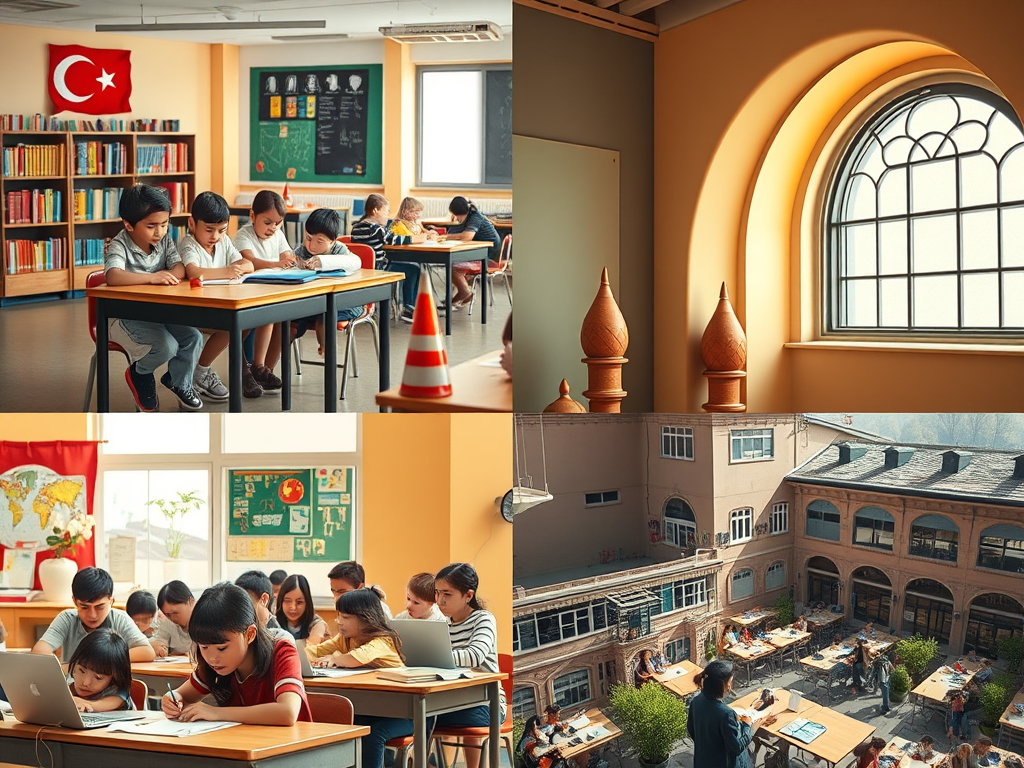
From Primary School to University
Overview of the Education System
Education in Turkey is compulsory for 12 years, covering primary, secondary, and high school education. The system is overseen by the Ministry of National Education (Milli Eğitim Bakanlığı, MEB), which sets curricula, standards, and regulations for public schools. Private schools also operate under ministry guidelines but often provide additional programmes and foreign curricula.
Turkey’s education system is divided into several stages:
1. Pre-School Education
- Pre-school education is available for children aged 3 to 6 years.
- It is optional, but increasingly popular, especially in urban areas, to prepare children for primary school.
- Focus is on early socialisation, basic literacy, numeracy, and creative development.
2. Primary Education
- Primary education begins at age 6 and lasts four years (grades 1–4), forming part of the 12 years of compulsory schooling.
- Curriculum includes Turkish language, mathematics, science, social studies, art, music, and physical education.
- Instruction is primarily in Turkish, though foreign language lessons start from early grades, often English.
3. Secondary Education
- Middle school (grades 5–8) continues compulsory education, focusing on more advanced subjects, including history, geography, mathematics, science, and foreign languages.
- High school (grades 9–12) offers general, vocational, or specialised education paths:
- General high schools: Standard academic curriculum.
- Vocational and technical schools: Focused on preparing students for careers or technical professions.
- Science, Anatolian, and social science high schools: Emphasise advanced academic preparation for university entry.
- High school concludes with the Lise Bitirme Sınavı (High School Graduation Exam) and forms the basis for university admission eligibility.
4. University Education
- University education in Turkey is managed by the Council of Higher Education (YÖK).
- Students must pass the Yükseköğretim Kurumları Sınavı (YKS) — a nationwide university entrance exam — to gain admission.
- Undergraduate programmes typically last four years, except for some engineering, architecture, or medical programmes which can last 5–6 years.
- Postgraduate programmes (Master’s and PhD) are available in numerous fields, with instruction in Turkish or English depending on the university.
- Turkey has over 200 universities, including prestigious public institutions like Boğaziçi University, Middle East Technical University (METU), and Istanbul University, as well as private universities like Koç University, Sabancı University, and Bilkent University.
Standards and Quality
- Turkey has made significant improvements in education access and literacy rates over the last few decades.
- Literacy among young adults is high, around 97%, and school enrolment rates have increased significantly.
- Challenges remain in rural areas and in terms of quality of education, with differences between urban and rural schools.
- International assessments like PISA (Programme for International Student Assessment) have shown Turkish students perform around the OECD average, with stronger performance in mathematics and science in some urban schools.
International Recognition and Opportunities
- Many Turkish universities are increasingly ranked in international league tables and attract foreign students.
- Programs taught in English are becoming more common, particularly at private universities and for postgraduate studies.
- Turkey is a participant in international student exchange programmes, including Erasmus+, and collaborations with European and Asian universities.
Key Points for Students and Parents
- Compulsory Education: 12 years (primary + secondary)
- Languages: Turkish is the main language; English and other languages increasingly taught.
- University Entrance: Requires passing the YKS exam; competitive for top universities.
- Vocational Pathways: Available from secondary school onwards.
- Global Opportunities: Students can study abroad or in English-medium programmes within Turkey.
Conclusion
Turkey’s education system has evolved rapidly in the past century, moving from limited access in the early Republic to a comprehensive system offering primary, secondary, and tertiary education to millions. While disparities in quality still exist, particularly between urban and rural areas, the overall standards are improving, and Turkish universities are gaining recognition internationally. For students, Turkey offers a range of academic opportunities, vocational pathways, and the potential for international engagement.



Leave a Reply