


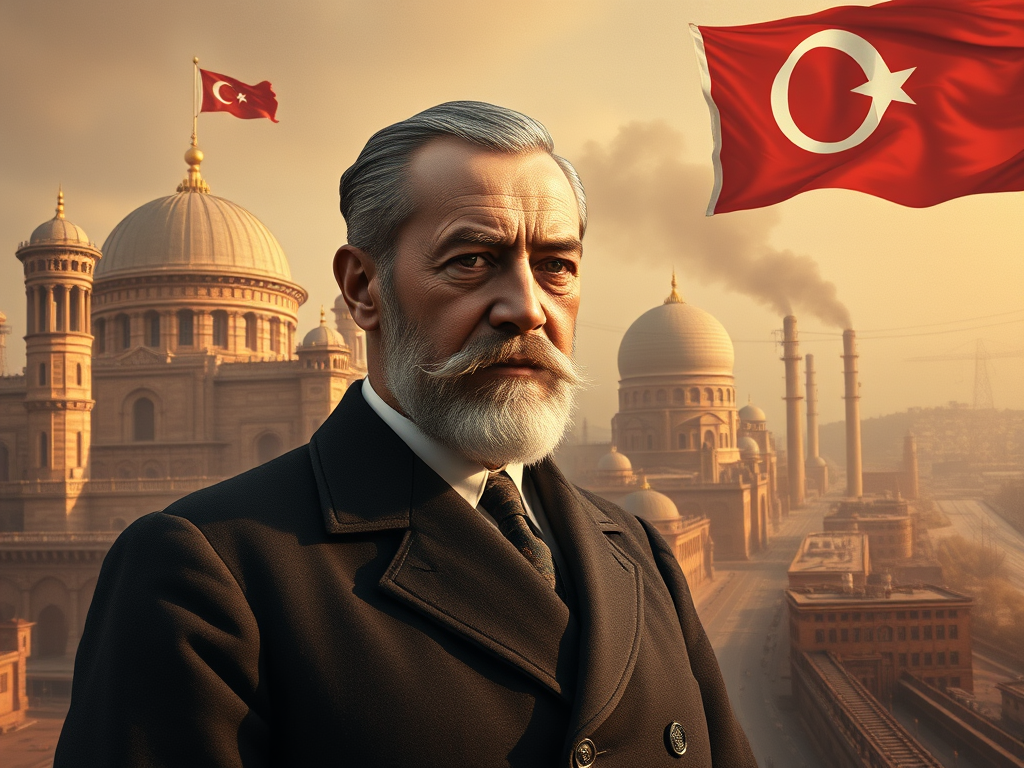
The Formation and Development of Modern Turkey: From Empire to Republic
The End of an Empire
Turkey, as a modern nation-state, is just over 100 years old. Before its establishment, the land we now call Turkey was the heart of the Ottoman Empire, one of the largest and longest-lasting empires in history. At its peak, the Ottoman Empire spanned Southeast Europe, Western Asia, and North Africa. However, by the late 19th and early 20th centuries, the empire was in decline. It was often referred to as the “sick man of Europe”, struggling economically, militarily, and politically.
The First World War and Its Aftermath
The Ottoman Empire sided with Germany and the Central Powers during the First World War (1914–1918). Following defeat, the empire faced occupation by Allied forces, loss of territory, and severe economic hardship. Turkish nationalism began to rise under the leadership of figures determined to restore sovereignty and independence.
The War of Independence
Led by Mustafa Kemal Atatürk, a military officer and visionary leader, the Turkish War of Independence (1919–1923) fought off occupying forces, including Greek, Armenian, French, and British troops. This struggle ended with the Treaty of Lausanne in 1923, which recognised the borders of the new Turkish Republic.
The Birth of the Republic
On 29 October 1923, the Republic of Turkey was officially proclaimed, with Mustafa Kemal Atatürk as its first president. Atatürk introduced sweeping reforms to modernise the country:
- Abolishing the sultanate and caliphate.
- Introducing a secular legal system.
- Modernising education, language, and government institutions.
- Promoting industrialisation and infrastructure development.
Early Challenges: Poverty and Underdevelopment
During the early decades of the republic, Turkey faced significant challenges:
- The economy was largely agricultural, with limited industrial base.
- Infrastructure such as roads, railways, and utilities was underdeveloped.
- Poverty was widespread, especially in rural areas.
Despite these obstacles, gradual modernisation laid the groundwork for the country’s later growth.
Cyprus, Geopolitics, and Military Engagements
Turkey became involved in international affairs, most notably during the Cyprus conflict of 1974, which arose from tensions between Greek and Turkish Cypriots. Turkish military intervention ensured the establishment of a de facto division of the island, creating the Turkish Republic of Northern Cyprus, recognised only by Turkey.
Tourism Takes Off
By the mid-20th century, tourism began to flourish, initially along the Aegean and Mediterranean coasts. Turkey’s rich history, ancient ruins, beautiful beaches, and warm climate attracted visitors from Europe and beyond. Over time, tourism became a major contributor to the economy, helping fund infrastructure and urban development.
Industrialisation and Rapid Development
From the 1950s onwards, Turkey underwent a process of rapid industrialisation:
- Expansion of textile, automotive, and electronics industries.
- Significant investment in roads, bridges, airports, and energy infrastructure.
- Urbanisation led to the growth of major cities like Istanbul, Ankara, Izmir, and Bursa.
By the 21st century, Turkey had transformed from a largely agricultural, underdeveloped country into a dynamic, industrialising nation with a diversified economy.
Modern Turkey
Today, Turkey is a country of contrasts: a modern industrial and economic hub, yet deeply connected to its rich historical and cultural heritage. It balances its geopolitical significance, thriving tourism sector, and industrial base, while facing challenges typical of nations with rapid development — such as urban growth, environmental pressures, and economic fluctuations.
Despite having only existed for just over a century, Turkey’s history is one of resilience, transformation, and ambition, turning the legacy of a declining empire into a modern republic recognised on the global stage.